Tog Tester
An instrument to measure the thermal resistance of bedquilts in the range from 4 to 18 tog. in accordance with BS5335-1:1991 using the guarded hotplate principle.
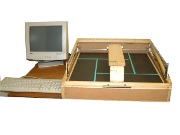
The equipment consists of a hotplate assembly, a control panel and a set of air temperature sensors.
Simple operation.
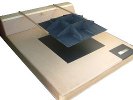
Place a conditioned quilt on the hotplate. Press the start button. When test is complete, a green light comes on. The results can be read from a network PC or a local VDU.
To construct a tog measurement laboratory requires
- This instrument
- A closed air conditioned room maintained near 20°C and 65%RH
- A table to support the hotplate and on which the quilt can lie flat
- A moveable frame (or optional regulating hood) to support the air temperature sensor array about 100mm above the quilt.
- A storage area at nominally the same temperature and humidity for pre-conditioning the quilts
- 230V ac mains supply fused at 5A
- Network or other communications connection.
- A (non-dedicated) PC or terminal for recording results.
- Annual calibration to national reference sample
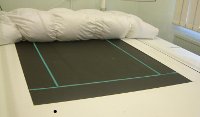
The hotplate working surface measures 1.0m x 1.32m, the complete hotplate assembly is 1.2m x 1.55m x 116mm high. and weighs about 40kg
The control system is supplied in a server-style tower PC case.
Heat up time from cold about 5 hours. Test time (to BS5335) about 5 hours.
The control system is based on a Linux PC, intended primarily to act as a network data server, although local output is available.
Client software for printing certificates on a PC running Microsoft Windows™ is included.
Baby Products
A smaller version of the system is available for testing cot bedding, baby sleeping bags, etc. in accordance with the UK Baby Products Association code of practice. Price and details on request.
Air conditioning
To meet British Standards the air conditioning must provide air temperature stable to ±0.1°C over hours. This can be achieved if a standard air conditioner is run in "proportional" mode and a large plenum is provided to smooth the airflow, for example distributing the air through the room ceiling cavity, or if the air conditioner includes a regulated post-cooling heater to provide precise temperature control.
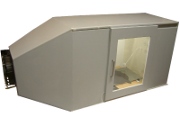
A regulating hood is available as an alternative method of smoothing the temperature fluctuations from a standard air conditioner. Use of the hood requires that the room temperature be set about a degree below the working temperature (nominally 20°C). The hood draws in air from the room, heats it to a precisely controlled temperature and distributes it over the bed. It is not an alternative to air conditioning, it only provides the post-cooling re-heater function, it does not cool or humidify the air. It does provide mounting for the air temperature sensors, and so eliminates the need for a separate frame, but it still requires a hoist or other moveable support arrangement.
Price
The instrument complete with delivery and installation in the mainland UK is £6000 plus VAT
Optional temperature regulated hood £500 plus VAT
Does not include table, air conditioning, reference materials etc.
Technical details
This precision instrument requires minimal calibration and is capable of 1% accuracy given suitable environmental controls.
Hotplate and guard plate temperature 33°C ±0.1°C
Temperature variations across surface and between plates less than 0.02°C
Overtemperature protection on all heaters
Heat output during test 5-18W. Extraneous heatflow less than 20mW.
Guard temperature control by thermopile sensor with chopper stabilised thermally controlled amplifiers giving uncalibrated accuracy better than 0.005°
Absolute temperature sensing by platinum resistance sensor with chopper stabilised amplifier giving stability of around 0.1° per year.
Hotplate powered from a stabilised DC supply with voltage and current measured independently and continuously.
Computer interface includes autocalibration facility which guarantees voltage measurements to 0.1%
Software implements procedure BS5335-1:1991 Appendix D section 4. Other procedures available on request.
All system temperatures over entire measurement cycle recorded for validation.
Local VDU output can report results and test progress.
A temperature output to a remote-sensing air conditioning unit can be provided
Software can be upgraded over the internet.
Compliant with CE regulations for electrical safety and EMC.
Hood Specifications
Max temperature rise 2°C
Air exit velocity 5cm/s
Heater power 100W
Weight approx 10kg